Why Your Bookkeeper Shouldn't Be Emailing You Tax Documents
If your bookkeeper sends your tax returns, bank statements, or financial reports as email attachments, your most sensitive financial information is traveling in one of the least secure ways possible. It feels normal because everyone does it — but normal and safe are not the same thing.
What Actually Happens When You Send a File by Email
Most people picture email as a direct line between two people. It is not. When you send a file, it passes through multiple mail servers before it reaches the recipient. It may sit on servers you have never heard of, in formats that are far easier to intercept than most people realize.
Your tax documents contain your Social Security number or Employer Identification Number, your revenue figures, your bank account details, and often your employees' information too. That is exactly what identity thieves are looking for. A single intercepted attachment can hand them everything they need.
Email is also easy to spoof. Criminals send emails that look like they came from a trusted source — including your bookkeeper — with attachments that look legitimate. If your financial workflow runs through email, it is much harder to spot a fake.
What "Secure" Actually Means for Financial Documents
A genuinely secure document workflow has a few things working together:
Encryption in transit. The file is protected while it is moving between systems, not just when it arrives.
Encryption at rest. The file is protected while it is sitting on a server, not just while it is moving.
Access controls. Only the people who are supposed to see the document can get to it, with a login and ideally multi-factor authentication required.
An audit trail. You can see when the file was uploaded, when it was accessed, and by whom.
Standard consumer email — even Gmail — does not reliably deliver all four of those things. A purpose-built client portal does.
The Bookkeeping Connection
Your bookkeeper works with your most sensitive financial data all year long. Bank statements, payroll records, tax filings, profit and loss reports. A good bookkeeper is not just someone who reconciles your accounts — they are a steward of information that, in the wrong hands, could do real damage to your business and your personal finances.
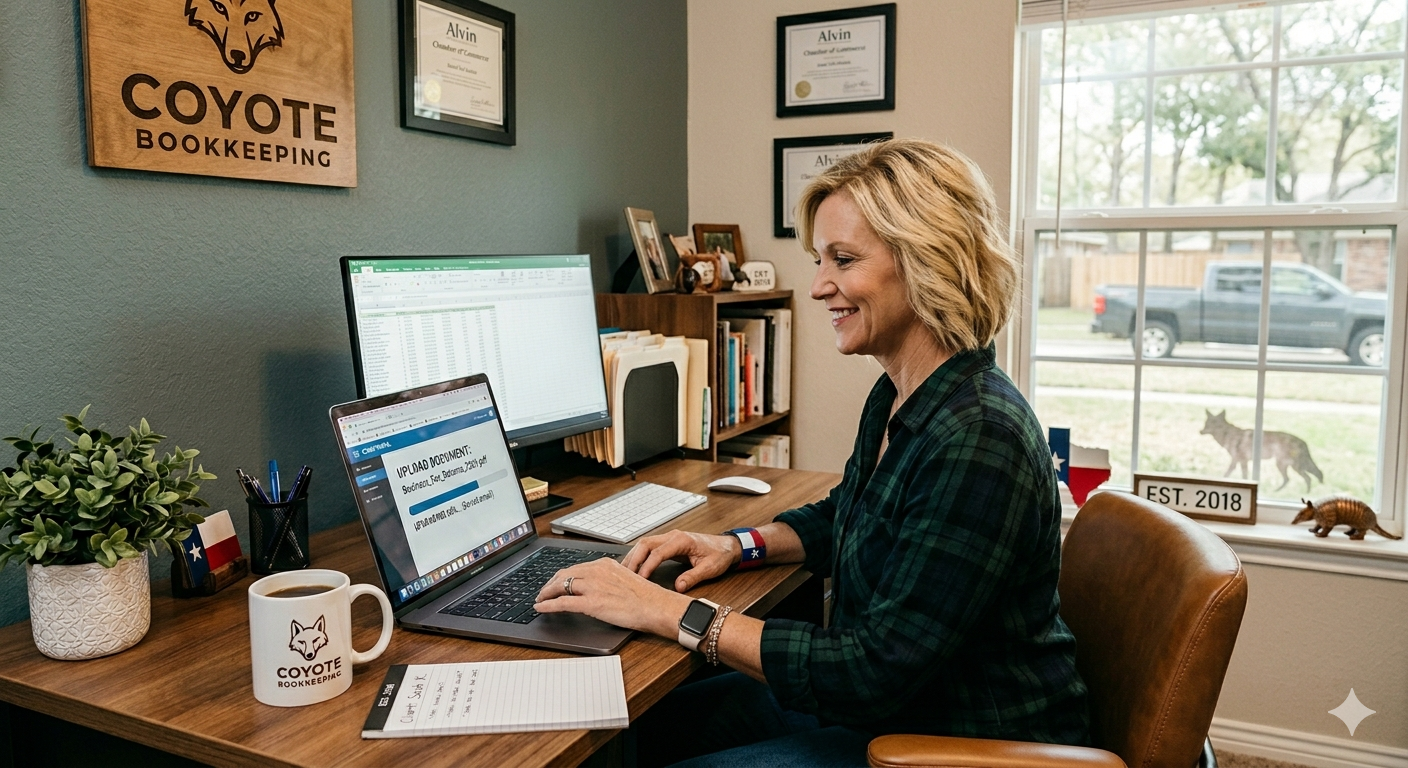
At Coyote Bookkeeping, secure document management is part of how we work with every client. That means your documents go through a portal, not an email chain. You get a simple upload link, your files land in a protected environment, and nothing sensitive is floating around in anyone's inbox.
It also makes the workflow cleaner. No hunting through old emails for last year's return. No "can you resend that?" No wondering whether you sent it to the right address.
What to Ask Your Bookkeeper
If you are not sure how your current bookkeeper handles your documents, these are worth asking:
Where are my files stored, and is that storage SOC 2 compliant?
Are documents transferred by email or through a secure portal?
Who has access to my files, and how is that access controlled?
Is multi-factor authentication required to access my documents?
A bookkeeper who takes security seriously will have clear answers to all of these. If the answer to the first question is "I just email them," that is worth addressing.
A Note on Texas Small Businesses Specifically
Brazoria County and the Greater Houston area have seen significant growth in small businesses over the last several years. More businesses mean more targets. Cybercriminals do not only go after big companies — small businesses are frequently targeted because they often have less security infrastructure in place.
The good news is that getting your document workflow right is not expensive or complicated. It mostly requires working with a bookkeeper who has already built it into how they operate.
If your financial documents are moving through email right now, is that a risk you have consciously decided to accept — or one you just never thought about?
Coyote Bookkeeping uses secure, compliant document handling for every client. Book a free consultation to learn how we keep your financial information protected.